
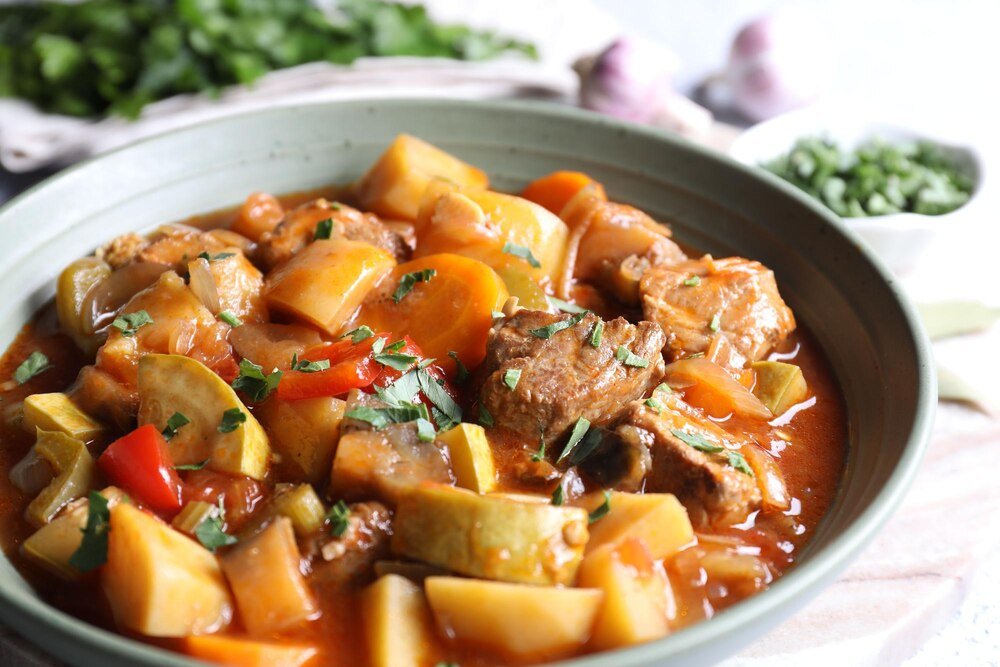
Hungarian food tends to intimidate people at first glance: unfamiliar names, rich stews, and a lot of paprika. In reality, the basics are straightforward once a few key dishes are understood. This overview focuses on the most famous Hungarian dishes, what makes them special, and how they relate to each other, so it becomes clear what to order, cook, or look for when exploring this cuisine.
What Makes Hungarian Cuisine Stand Out
Hungarian cooking is built around a few core ideas: slow-cooked meats, generous use of paprika, and simple ingredients that turn surprisingly rich with time and fat. Instead of long lists of spices, many classic dishes rely on onion, fat, paprika, and meat as the base.
There is also a constant balance between hearty and slightly tangy flavors. Sour cream, pickles, and fermented elements show up often. Even the richest dish is usually paired with something that cuts through the fat: a slice of bread, pickled pepper, or a spoon of sour cream.
Hungarian paprika is not just “chili powder”. It ranges from sweet and mild to fiery hot, and the quality dramatically changes the taste and color of stews and soups.
Most of the famous dishes are not restaurant inventions. They come from home kitchens, countryside traditions, or shepherd cooking, which is why they are filling, practical, and made to feed a crowd.
Gulyás – More Than Just “Goulash”
Gulyásleves (goulash soup) is probably the best-known Hungarian dish outside the country, but it is often misunderstood. In Hungary, gulyás is primarily a soup, not a thick stew, and it is usually served as a full meal, not just a starter.
The base is simple: beef (often shank or another stewing cut), onions, paprika, caraway seeds, and root vegetables like carrot and parsnip. Potatoes and small dumplings called csipetke are often added to make it more filling. It is bright red, aromatic, and only moderately spicy unless explicitly made “hot”.
Key ingredients and variations
Classic gulyás starts with slowly sweating a lot of chopped onion in fat (traditionally pork lard, sometimes oil). Paprika is added off the heat so it does not burn, then the meat is seared in this mixture. Water is added to build a soup rather than a sauce, and the vegetables go in later so they do not overcook.
There are regional versions, such as:
- Alföldi gulyás – from the Great Hungarian Plain, often a bit more rustic and spicy
- Babgulyás – a bean gulyás, denser and extremely filling
- Bográcsgulyás – cooked in a kettle (bogrács) over open fire, with a smokier character
The open-fire version is often considered the “real thing” by Hungarians. The slight smokiness and the slower evaporation give it a deeper flavor. But even at home on a stovetop, using good-quality sweet paprika already makes a huge difference.
When eaten in Hungary, gulyás is usually served with bread and sometimes a sharp pickled pepper. It rarely needs anything else. If a restaurant serves a very thick, gravy-like “goulash” as a side dish, that is usually closer to pörkölt than to true gulyás.
Pörkölt and Paprikás – The Saucy Siblings
If gulyás is the famous cousin, then pörkölt and paprikás are the everyday heroes of Hungarian kitchens. These are the rich, spoon-coating stews that people associate with cold weather and family lunches.
Both start in a similar way: onion, fat, paprika, meat. The result is a thick, concentrated sauce that clings to the meat rather than floating around it. The difference lies mainly in the finishing touches.
Pörkölt vs. Paprikás: what’s the difference?
Pörkölt is the more straightforward dish. It is a paprika stew with meat and a reduced sauce, typically without dairy. Beef, pork, lamb, or even tripe can be used. The flavor is bold, meaty, and slightly smoky from the paprika. Side dishes are usually nokedli (small egg dumplings similar to German Spätzle), boiled potatoes, or simple white bread.
Csirkepaprikás (chicken paprikash) is the most famous paprikás. The base is almost identical to pörkölt, but sour cream is stirred into the sauce near the end, making it velvety and slightly tangy. The sauce becomes a lighter red-orange, and the overall flavor is smoother and creamier.
In practice, the terms sometimes blur in everyday talk. Some families refer to their chicken dish as “pörkölt” even if sour cream lands in there. In restaurants focused on tradition, the line is clearer: pörkölt tends to be richer and more intense, paprikás milder and creamier.
Both dishes usually come with noodles or dumplings that soak up the sauce. Bread works too, but nokedli holds onto the sauce better and is considered the classic pairing, especially with paprikás.
For anyone trying Hungarian food for the first time, ordering csirkepaprikás nokedlivel (chicken paprikash with dumplings) is a safe and very representative choice. It captures the essential Hungarian flavor profile without being heavy on spice heat.
Lángos – Hungary’s Street Food Star
Lángos is deep-fried flatbread, usually topped with garlic, sour cream, and grated cheese. It is cheap, filling, and addictive. This is the dish that shows up at markets, festivals, baths, and roadside stands across the country.
The dough is made with flour, yeast, water (sometimes milk), and a bit of oil. It is stretched into a rough disc and fried until puffed and golden, crispy at the edges and soft inside. The classic version is brushed with garlicky water, then loaded with sour cream and cheese. There are variations with ham, sausages, or even sweet toppings, but the “tejfölös-sajtos lángos” (sour cream and cheese) is the standard.
Quality varies a lot. Freshly fried, not greasy, and well-seasoned lángos is fantastic. Old oil or pre-fried versions are a letdown, so there is usually a reason why one stand has a line and the others do not.
Lángos is traditionally more of a snack or street food than a home-cooked dish. At thermal baths or lakeside spots like Balaton, eating lángos between swims is almost a ritual.
Stuffed Cabbage and Other Comfort Classics
No overview of famous Hungarian dishes is complete without mentioning töltött káposzta – stuffed cabbage. It is a strong candidate for the ultimate winter and holiday food in Hungary.
The core idea is simple: cabbage leaves are filled with a mixture of minced pork (sometimes mixed with rice), paprika, and seasonings. These rolls are then cooked slowly in a sauerkraut base, often with smoked meats or bacon, until everything blends into a deeply savory, slightly sour stew.
The result is rich but not flat. The fermented cabbage gives a sharpness that cuts through the fattiness of the pork. A spoonful of sour cream on top is common, because sour cream appears everywhere in Hungarian comfort dishes.
Other related classics worth knowing:
- Lecsó – a pepper and tomato stew, sometimes with sausage or eggs; often compared to ratatouille but simpler
- Hortobágyi palacsinta – savory crêpes filled with pörkölt, baked in a creamy paprika sauce
- Rakott krumpli – layered potatoes with sausage, eggs, and sour cream, baked until golden
These dishes might not be as internationally famous as goulash, but in Hungarian households, they are just as beloved and appear often in rotated weekly menus or family gatherings.
Hungarian Sweets: From Dobos Torte to Kürtőskalács
Hungary’s pastry tradition is serious and rooted in both Austro-Hungarian and local influences. Bakery windows are usually full of layered cakes, rich creams, and intricate shapes.
Iconic Hungarian desserts
Dobos torta is a layered sponge cake filled with chocolate buttercream, topped with a thin, glassy caramel sheet. The top is usually cut into wedges, each carrying its own caramel “roof”. It is rich and slightly old-fashioned in feel, in a good way – perfect with strong coffee.
Somlói galuska looks messy but tastes luxurious. It combines pieces of sponge cake (often three flavors: plain, walnut, and cocoa), soaked with rum syrup, layered with walnuts, raisins, and vanilla custard, then topped with whipped cream and sometimes chocolate sauce. It is a typical restaurant dessert and a classic example of Hungarian “controlled chaos” in a bowl.
Kürtőskalács (chimney cake) is cylinder-shaped pastry baked on a rotating spit. The dough is wrapped around a wooden (now often metal) roll, brushed with butter, rolled in sugar, and baked until caramelized outside and soft inside. Then it is dusted with cinnamon, walnut, cocoa, or other coatings. It is popular at Christmas markets and touristy areas, and the smell alone tends to pull people in.
On the simpler side, there is rétes – strudel, usually filled with apple, sweet curd cheese, or poppy seeds. It is thinner, flakier, and less sugary than many Western pastries, which makes it easy to eat more than intended.
Across these desserts, the common pattern is clear: multiple layers, strong flavors (walnut, poppy seed, chocolate, caramel), and an unapologetically generous use of sugar and fat.
How to Taste These Dishes Properly
To really understand Hungarian dishes, context helps a lot: how they are served, what they are eaten with, and when they show up on the table.
- Order gulyásleves as a main, not a starter – with bread.
- Try a pörkölt or paprikás with nokedli to see true “paprika stew” style.
- Grab lángos from a busy stand, preferably freshly fried.
- Look for töltött káposzta in winter or around Christmas for its best, slow-cooked versions.
- Finish with a classic dessert like Dobos torta or somlói galuska.
At home, starting with one dish from each “category” works well: gulyás for soup, csirkepaprikás for stew, lángos for street food, and kürtőskalács or rétes for dessert. Many recipes look long because of technique descriptions, but the ingredients themselves are usually simple and accessible.
Once these famous dishes are familiar, the rest of Hungarian cuisine stops seeming opaque and turns into a recognizable pattern: onion, fat, paprika, slow cooking, and a good reason to keep a tub of sour cream in the fridge.